|
|
||||||
 |
||||||
 |
image | activities | contacts | links | italiano | |||||
|
|
||||||
|
introduction |
Interaction Design Institute Ivrea develops our capacity to innovate
new products and services. These services help us interact with each
other in new ways -through communications, network and information technology.
Interaction-Ivrea, which combines a masters programme and clusters of
future concept projects, is part of Telecom Italia's Progetto Italia. Interaction-Ivrea aims to: Innovate. To find new ways to design in the medium of tele-communications - through future concept projects which demonstrate the role of interaction design in the development of services and the devices that allow us to interact with them. Educate. To teach a group of designers to be pioneers in this field -through an international multidisciplinary masters course. Communicate. To be a centre for the dissemination of the culture of interaction design - what it is, how is it done and how it can lead to products and services which fit the needs and desires of ordinary people. Interaction-Ivrea, which opened in October 2001, is a non-profit association supported by private companies. Its founding sponsors are Telecom Italia and Olivetti. Gillian Crampton Smith, Director |
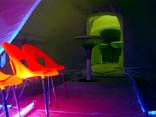 Installation at the Stazione Leopolda, Florence (photo by: Omar Cotza) |
||||
| Building
as Interface Instructors: Walter Aprile, Massimo Banzi, Stefano Mirti |
||||||
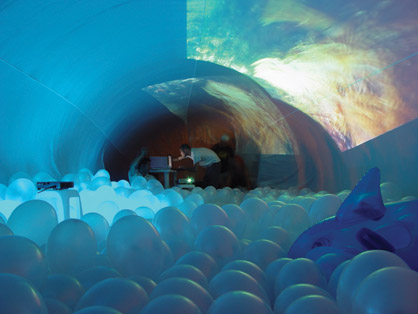
Inside inflatable environment prototype 1, nighttime, marine theme projections. Promenade, Reggio Calabria, July 2003, in collaboration with Corso IFTS. We will not present the output of a specific class, but rather the teaching related work in progress of our innovation group, composed of professors and students of Interaction Ivrea. The project members gathered around last year’s “Building as Interface” class. After the class, some students took part in an international design competition, about new spatial concept. Inflatable prototype number 1 was technologically simple, but it was enough for testing our starting hypothesis. Prototype number 2 introduced modularity, and we will use it for teaching in 2003-2004. We determined that, within our context, the inflatable makes sense because: it allows fast prototyping of space concepts and it is probably the cheapest form of building per cubit meter. We believe that these two characteristics will encourage the student to experiment, iterate and refine their ideas. After experimenting with the concept of modular inflatable environment, the next step we want to take (Prototype 3) is adding interactivity. Interaction will be a layer of capabilities superimposed on our current building system; every inflatable module will have either input (touch sensors, light sensors, buttons, presence sensors) or output (lamps, motors, projectors, LEDs, fans, inflatable objects) abilities. Our purpose is to define an open teaching platform, a tool to teach the relationship between space and new media, using interaction design as a main tool of enquiry. We want to define new possibilities for space, its transformations, its edges, its surfaces and the void. Can interaction design modify the way the form defines space? What are the most relevant qualities of this new architectural space? What spatial relationships are defined? concept of ‘space within space’, ‘circulation elements’, ‘paths’, ‘space relations’, ‘proportion’. We will bring this third prototype to Intimacy 2003 to share our experiment, to find other interested parties, and (if possible) to create new collaborations and links. Students: Dario Buzzini, second year student. He is the man of products. http://people.interaction-ivrea.it/d.buzzini/ Karmen Franinovic, second year student. She is the woman of concepts. http://people.interaction-ivrea.it/k.franinovic/ Eyal Fried, second year student. He is the man of cognitive sciences. http://people.interaction-ivrea.it/e.fried/ Daniele Mancini. second year student. He is the man of logic. http://people.interaction-ivrea.it/d.mancini/index.htm |
Walter Aprile teaches the Computer Technology course and provides
assistance on computer-related matters. He also takes part in several
Institute projects (like those developed for the Venice Biennale and
Trenitalia) together with other faculty and staff members. (http://www.interaction-ivrea.it/courses/2002-03/bitwisedesign) Massimo Banzi teaches courses in electronics and interactive physical computing. He supervises the Institute's electronics prototyping laboratory and advises students in all matters of hardware and software technology. He has also participated in various Institute projects (like the one developed for the Venice Biennale) together with other faculty and staff members. (http://www.interaction-ivrea.it/courses/2002-03/physicalcomputing) Stefano Mirti is in charge of architecture and space related activities at the Institute, as teacher, project developer and researcher. Recently he worked for the Institute on the Grace Under Pressure installation at the Venice Biennale. (http://www.interaction-ivrea.it/en/news/press/ interviews/mirti/index.asp) |
|||||
| site
hosted by ARCH'IT rivista digitale di architettura  www.architettura.it |
||||||